New horizons for science in Latin America
Abstract
Latin American science develops in a scenario marked by profound tensions and contrasts. On one hand, the region faces persistent structural challenges—environmental, social, technological, and educational; on the other, it possesses an active, creative scientific community committed to generating knowledge relevant to its realities. In this context, speaking of new horizons of science in Latin America refers not only to technological advances or the incorporation of emerging methodologies, but to a deeper transformation: the consolidation of a situated, critical, and socially responsible science.
Historically, much of the region's scientific production has been interpreted through external frameworks, with agendas defined outside our territories. However, the science produced in Latin America is neither marginal nor subsidiary; it is a science that engages with concrete problems, that emerges from specific contexts, and that seeks solutions adapted to local needs. In this sense, new scientific horizons are not limited to the frontier of global knowledge, but rather expand toward the construction of intellectual sovereignty, the strengthening of regional capacities, and the articulation between science, society, and development.
Scientific journals play a central role in this process. They function not only as repositories of results, but as spaces for validation, encounter, and projection of scientific thought. In Latin America, these platforms acquire particular relevance: they are vehicles for making visible research that, while meeting international quality standards, responds to the region's own problems and contributes to scientific development from a contextualized perspective.
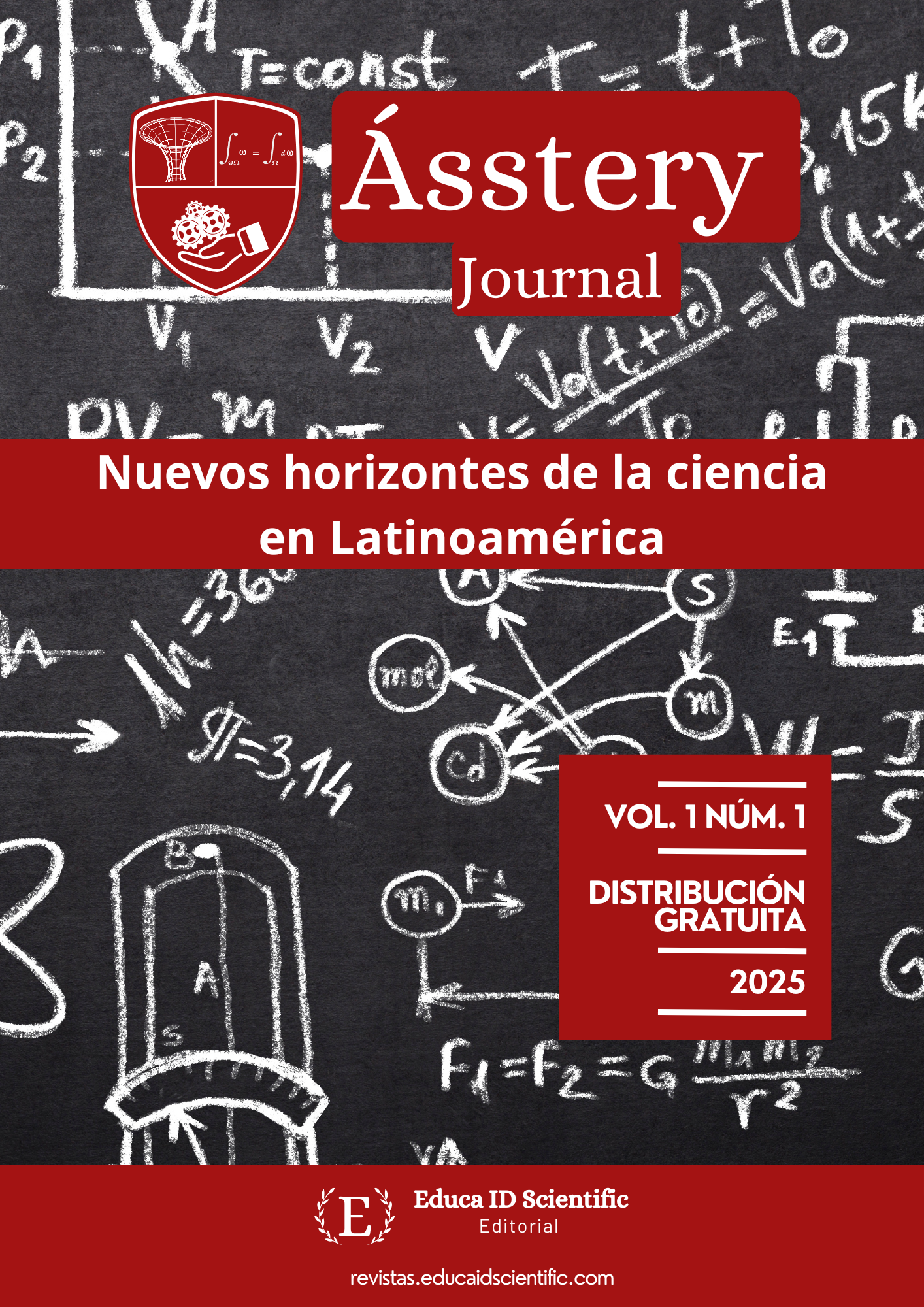
This first issue of the journal is born precisely from that conviction. New Horizons of Science in Latin America is not only the title of an inaugural edition, but a declaration of principles. It represents a commitment to a science that integrates theory and application, that articulates diverse disciplines, and that recognizes the value of knowledge produced in our countries. Likewise, it reflects the aspiration to consolidate an editorial space that promotes academic rigor, interdisciplinary dialogue, and open dissemination of scientific knowledge.
Published
How to Cite
Issue
Section
License
Copyright (c) 2025 Ásstery Journal

This work is licensed under a Creative Commons Attribution-NonCommercial-NoDerivatives 4.0 International License.


